

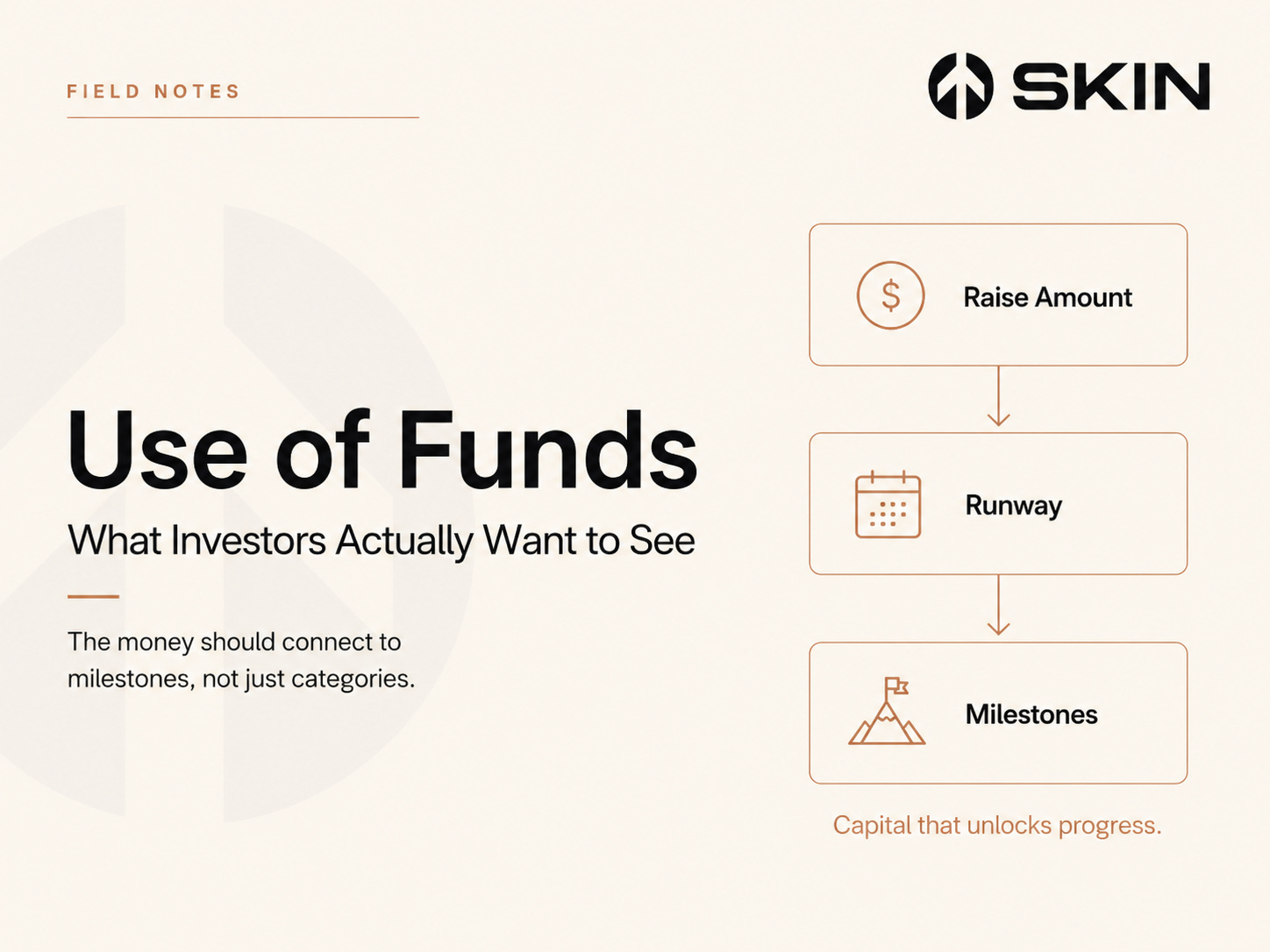
Most founders treat “use of funds” like a budget slide.
They write:
Product.
Hiring.
Marketing.
Operations.
That is not enough.
Investors do not only want to know where the money is going.
They want to know what the money will unlock.
The better question is:
What will be true about the company after this capital is spent?
That is what use of funds should answer.
The founder mistake
A weak use of funds slide sounds like this:
We will use the capital for product, sales, marketing, and team growth.
That is too vague.
It does not tell the investor:
How long the money lasts.
What the company will prove.
Which risks will be reduced.
What milestones matter.
Why this round size makes sense.
A stronger version sounds like this:
We are raising $1.5M to reach 18 months of runway, hire our first GTM lead, convert 10 pilots into paid customers, launch self-serve onboarding, and prove one repeatable acquisition channel.
That is clearer.
It connects capital to progress.
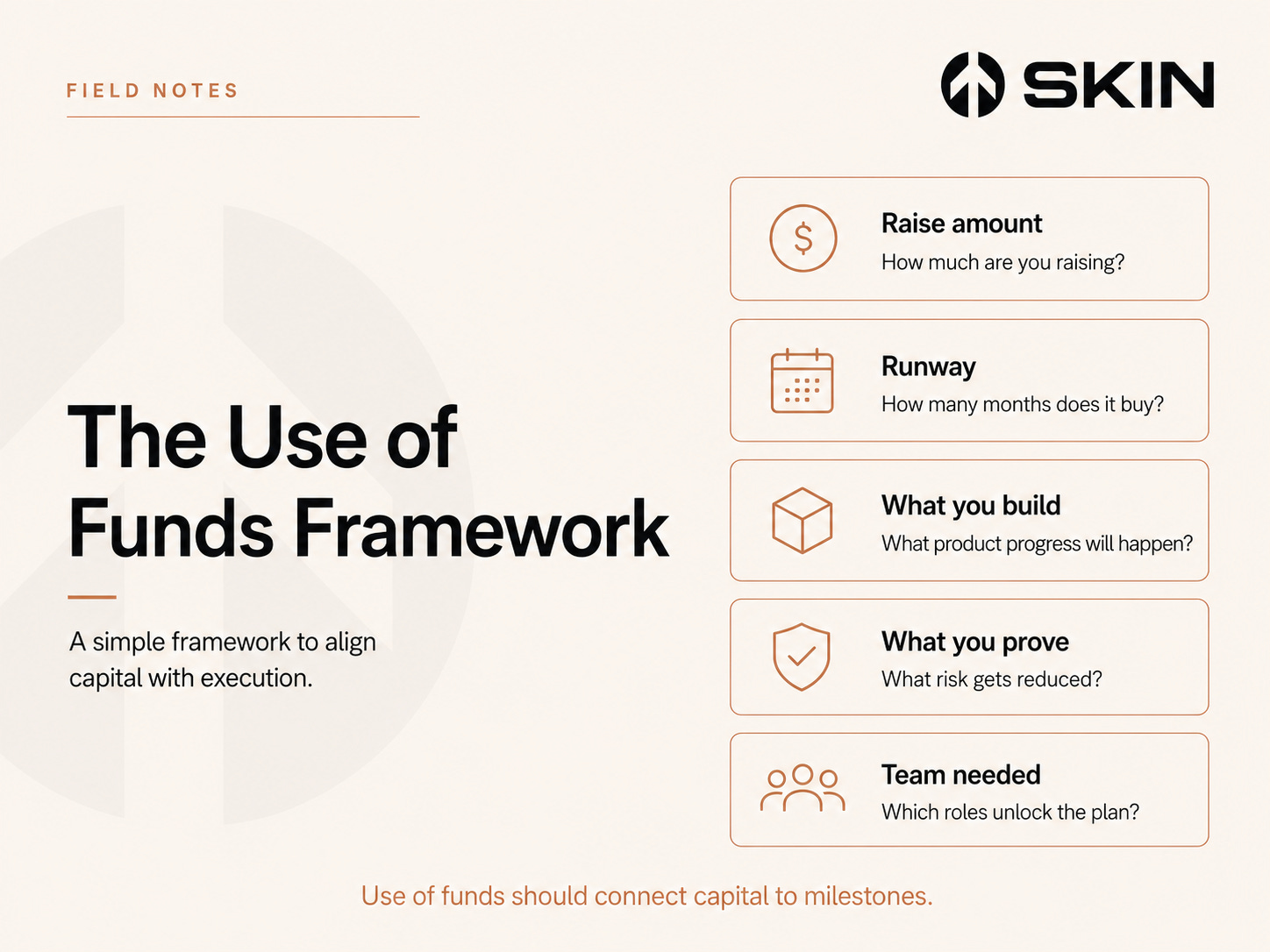
The simple use of funds framework
A good use of funds plan should answer five things.
1. How much are you raising?
Be specific.
Investors need to know whether the round size matches the company’s stage, ambition, and next milestones.
2. How much runway does it create?
Show how long the capital gives you.
Common early-stage targets are often 12–24 months, depending on stage, burn, and fundraising environment.
The point is not the exact number.
The point is showing you know how long the money lasts.
3. What will you build?
Be clear about product progress.
Examples:
Launch MVP.
Ship v2.
Move from services to software.
Launch self-serve onboarding.
Build core infrastructure.
Improve retention-critical workflows.
4. What will you prove?
This is the most important part.
Investors care about risk reduction.
Examples:
Prove customer urgency.
Prove repeatable acquisition.
Prove paid conversion.
Prove retention.
Prove pricing.
Prove gross margin.
Prove expansion potential.
5. What team do you need?
Do not just say “hiring.”
Explain which roles unlock the plan.
Examples:
Founding engineer to ship product faster.
GTM lead to test repeatable acquisition.
Customer success hire to improve retention.
Fractional finance support to manage reporting and runway.
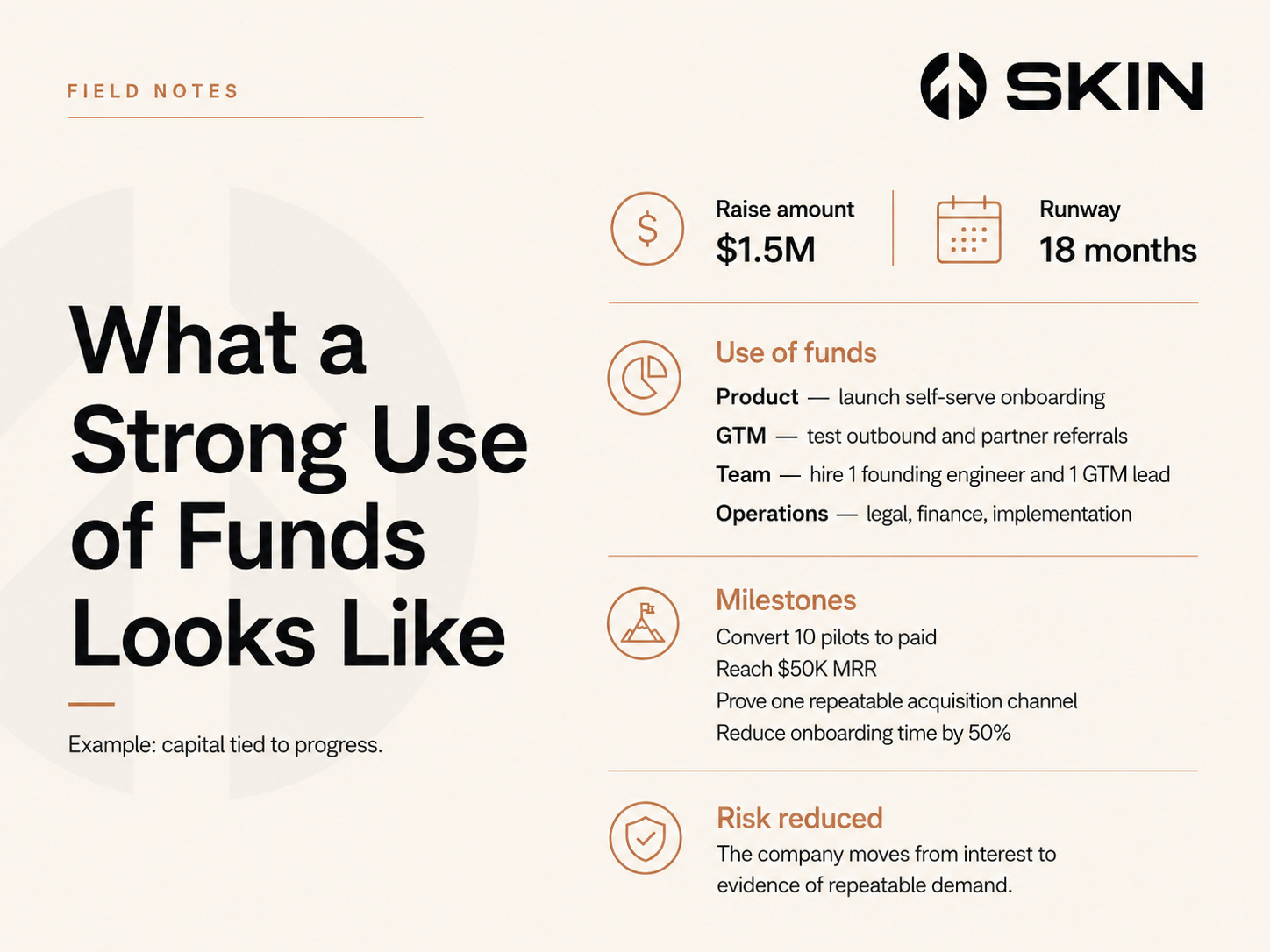
Better use of funds format
Use this structure:
Raise amount: $[X]
Runway: [X] months
Core use of funds:
Product: [What gets built]
GTM: [What gets tested or scaled]
Team: [Who gets hired and why]
Operations: [What support is needed]
Milestones this round unlocks:
[Milestone 1]
[Milestone 2]
[Milestone 3]
Risk reduced:
[What becomes less risky after these milestones are reached]
Example
Raise amount: $1.5M
Runway: 18 months
Use of funds:
Product: launch self-serve onboarding and improve activation.
GTM: test outbound, partner referrals, and founder-led sales conversion.
Team: hire one founding engineer and one GTM lead.
Operations: support legal, finance, and customer implementation.
Milestones:
Convert 10 pilots into paid customers.
Reach $50K MRR.
Prove one repeatable acquisition channel.
Reduce onboarding time by 50%.
Prepare for a seed round with stronger traction data.
Risk reduced:
The company moves from early customer interest to evidence of repeatable demand.
What investors are really looking for
Investors want to see that the founder understands the next stage of the company.
They are asking:
Is the round size realistic?
Does the runway make sense?
Are the planned hires necessary?
Do the milestones reduce real risk?
Will this capital create a stronger next financing story?
Does the founder know what needs to be proven next?
A good use of funds plan makes the next chapter obvious.
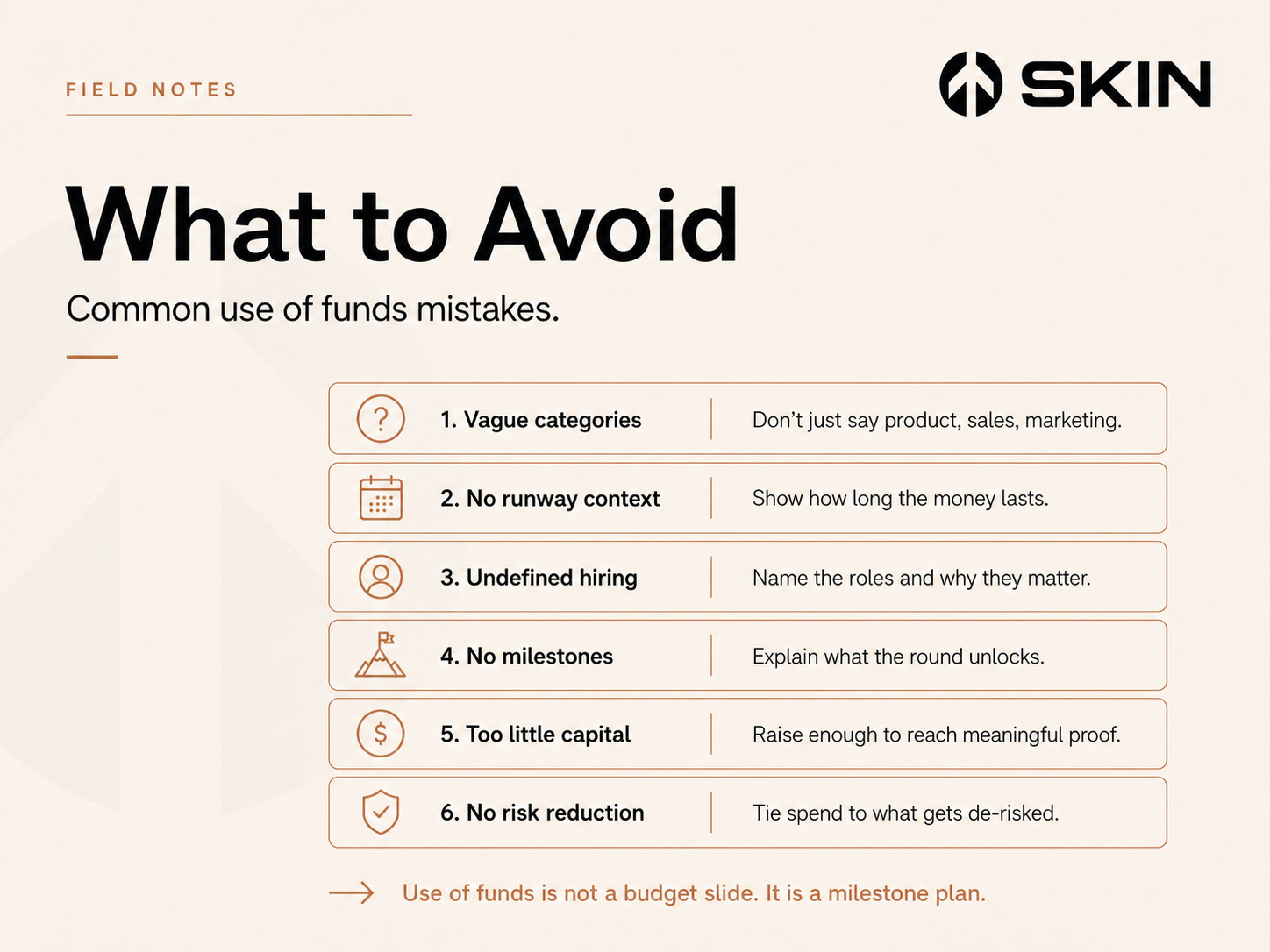
What to avoid
Do not use vague buckets.
Do not say “marketing” without explaining the channel.
Do not say “hiring” without naming the roles.
Do not raise too little to reach meaningful milestones.
Do not raise too much without explaining why.
Do not disconnect spend from risk reduction.
Do not make the investor guess what progress looks like.
The SKIN Take
Use of funds is not a spending plan.
It is a milestone plan.
The strongest founders can explain:
What they are raising.
How long it lasts.
What they will build.
What they will prove.
Who they need.
What risk gets reduced.
Capital should buy clarity.
If the money does not change the company’s risk profile, the use of funds is not strong enough.
Before you raise, know what the round unlocks.
Before you open your round
Know where you stand.
SKIN Fundable is a pre-raise diagnostic that helps founders assess investor readiness across narrative, market, traction, business model, team, and fundraising risk.
Run your Fundable diagnostic:
https://skin.global/fundable/
