

Every company has risk.
The mistake is pretending it does not.
Investors are not expecting early-stage startups to be risk-free. They are trying to understand whether the founder knows where the risk lives and what they are doing to reduce it.
That is why every founder should build an objection memo before opening a round.
What is an objection memo?
An objection memo is a short internal document that helps you prepare for the hard questions investors are likely to ask.
It should answer one simple question:
What concerns will investors have, and how are we reducing them?
The goal is not to sound defensive.
The goal is to show clarity.
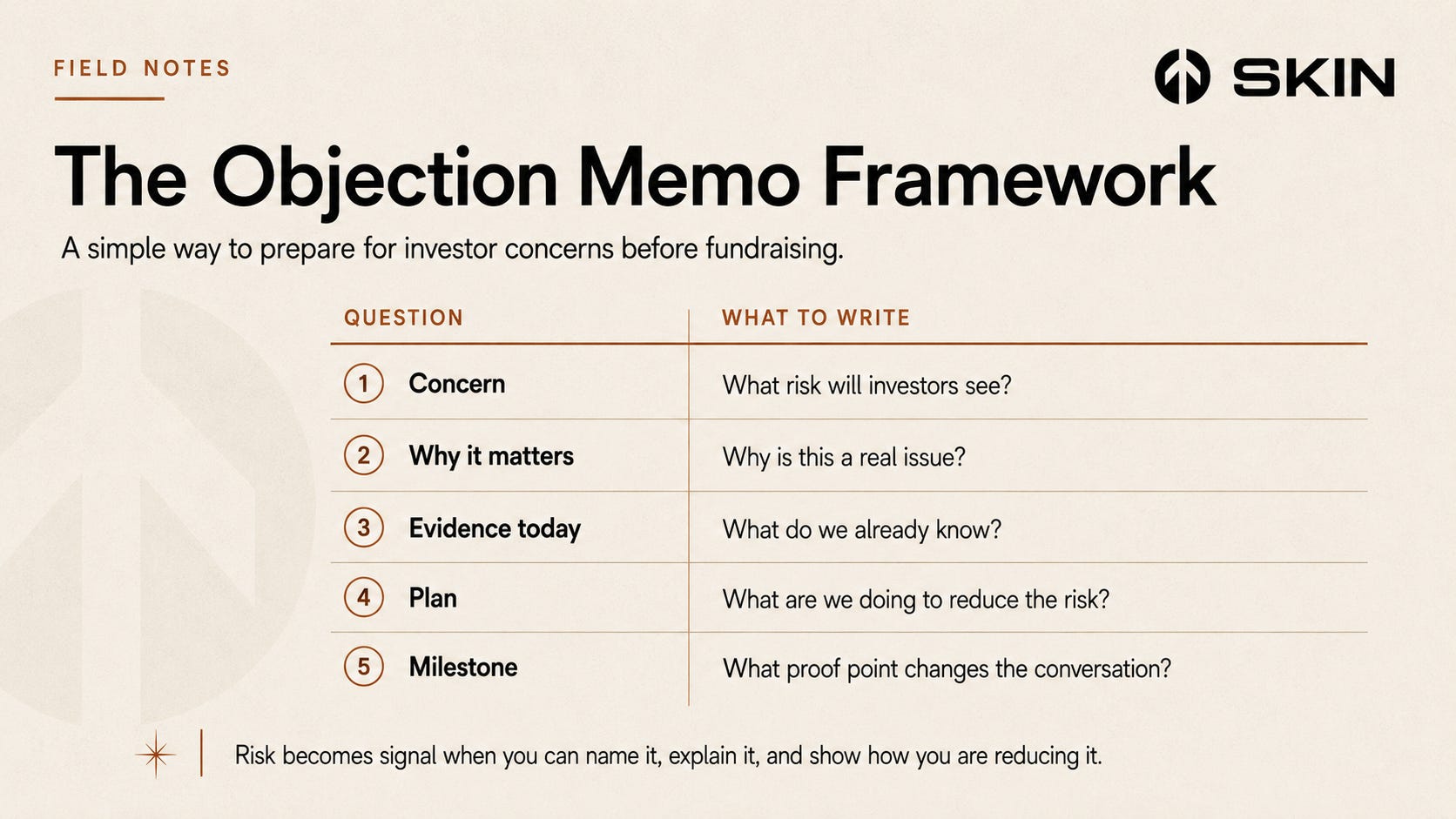
The simple framework
For every likely objection, use this structure:
Example
Objection
“Can this company acquire customers without founder-led selling?”
Concern
We have strong early interest, but most customers came through founder relationships.
Why it matters
If acquisition depends only on the founder, growth may not scale.
Evidence today
We have 12 active pilots and 4 paid conversions, but most came through warm intros.
Plan
Over the next 90 days, we are testing outbound, partner referrals, and content-driven inbound.
Milestone
If one channel creates qualified pipeline without founder-led intros, the acquisition risk becomes much lower.
Common objections founders should prepare for
Use these as prompts:
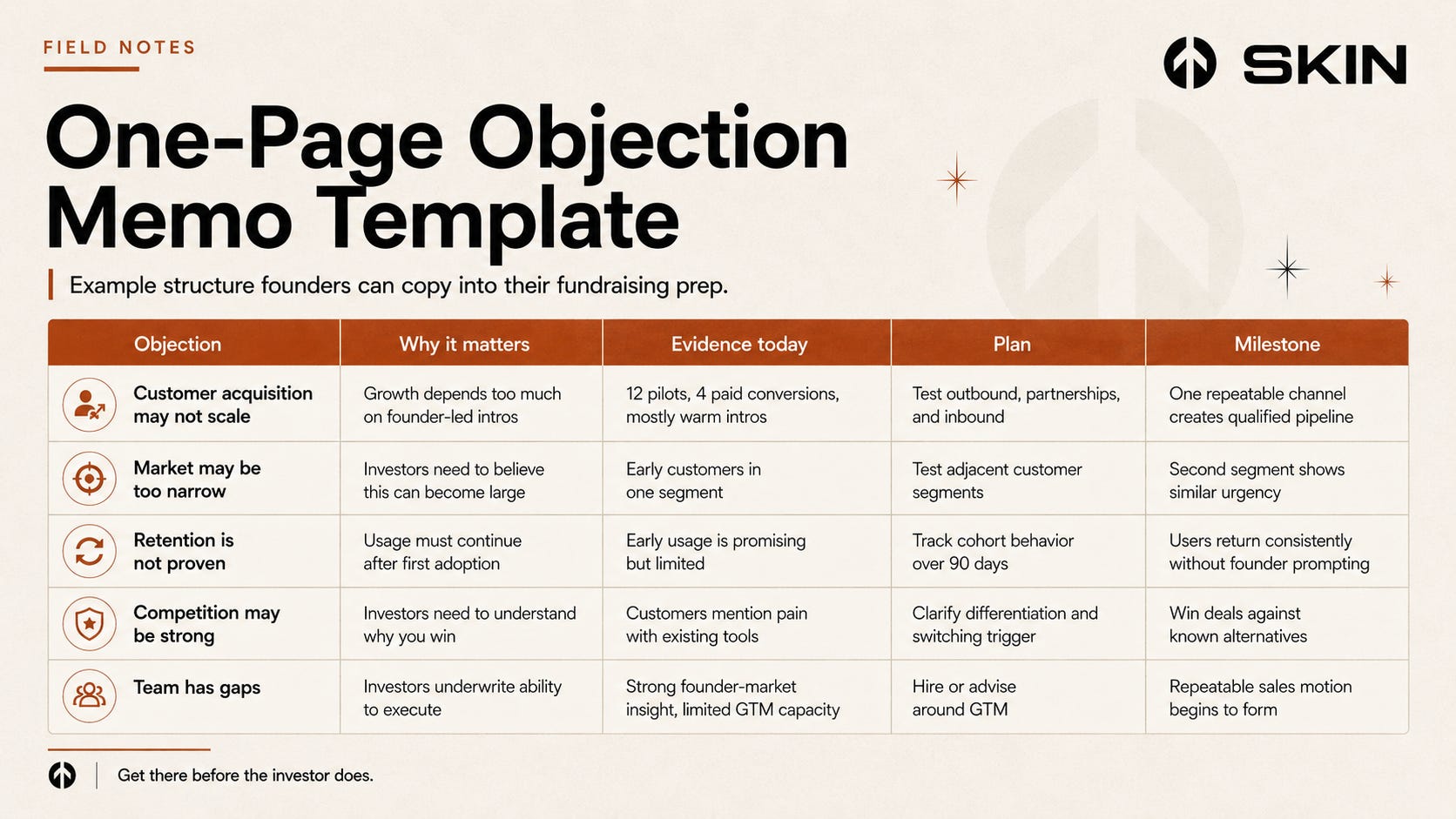
Market size
Is the opportunity big enough?
Customer urgency
Is this a real pain or a nice-to-have?
GTM repeatability
Can you acquire customers beyond founder-led selling?
Sales cycle
How long does it take to close customers?
Retention
Do customers keep using or paying?
Competition
Why do you win against alternatives?
Pricing
Will customers pay enough to support the business?
Margins
Can the business become financially attractive?
Team gaps
What key capabilities are missing?
Defensibility
What makes this hard to copy over time?
Capital efficiency
Can you create enough progress with the money raised?
One-page objection memo template
Founder mistake
Most founders wait for investors to surface the hard questions.
That puts them on defense.
The stronger move is to get there first.
When a founder can say:
“Here is the risk we see, here is what we know, and here is how we are reducing it,”
the conversation changes.
You stop sounding reactive.
You start sounding like an operator.
The SKIN Take
A strong objection memo does not make your company look weak.
It makes your thinking look sharper.
Investors already know there are risks.
The question is whether you understand them better than they do.
Before you open your round, write down the hard questions.
Then answer them with evidence, a plan, and a milestone.
That is how you turn risk into signal.
Before you open your round
Know where you stand.
SKIN Fundable is a pre-raise diagnostic that helps founders assess investor readiness across narrative, market, traction, business model, team, and fundraising risk.
Run your Fundable diagnostic:
https://skin.global/fundable/
